
Meet the author of Notions of Grace
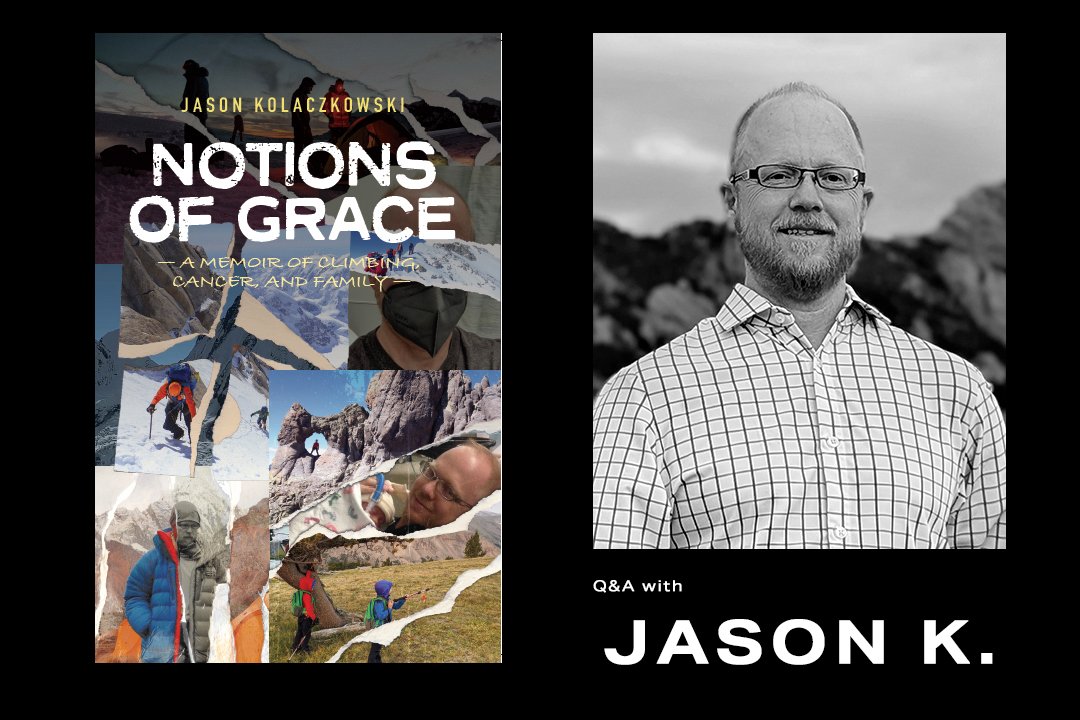
Jason Kolaczkowski, author of Notions of Grace: A Memoir of Climbing, Cancer, and Family is a father, husband, son, and brother. He is also a dedicated, amateur climber and is, currently, a cancer survivor - by definition, a transient state. He shares his passion of enabling families to get outdoors through a blog and YouTube channel called Short Guys Beta Works (www.shortguysbetaworks.com) as he, his wife, Kristina, and his twin sons, Connor and Kade, tramp amongst the peaks near their home in Colorado.
We asked him about writing and his feelings towards sharing a story so personal. Here’s what he had to say.
DAP: Notions of Grace began with you staring at a blinking cursor on a train, trying to write something honest. What was the first truth that finally came out when you started typing?
That's actually quoted in the book, in chapter fourteen. I was able to start writing when I finally realized that what I was feeling was guilt - guilt just about bringing uncertainty and risk into my kids' lives:
No parent wants to hurt their kids. In any way. Ever. But here I am. One day, I’m going to begin treatment. And it may work. But it may not. And that uncertainty is going to be scary. And it is going to be really scary for kids who see Dad as an indestructible superhero. I am going to hurt them, and I don’t know when. I want them to know how much I hate this. How much I already regret it.
DAP: You describe the book as something you wanted to “leave behind” for those you love most. At what point did it shift from a private reflection to something you felt ready to share publicly?
I really didn't think anyone else would be interested in it at all until after the first draft was done. As I circulated it among some people I trust for feedback, I received a lot of constructive criticism, but several people independently mentioned that the book touches on some universal themes others might find interesting. There were enough of those people that I started to believe it. In parallel, then, I started working more on the various story arcs, explicitly considering the mass market while also discussing with my family whether they felt comfortable sharing these stories.
DAP: How did the experience of writing differ from your experience of climbing—both involve solitude, endurance, and a confrontation with limits. Did one teach you how to face the other?
I think it's hard to separate the lessons I pull from climbing from the lessons I learn, and have learned, from the rest of my life. Climbing informs my life and my life informs climbing. That's probably a good thing, as I personally feel like climbing, at least my climbing, is kind of selfish. I feel like if I'm not open to it helping craft my character then it's just potential death with no redeeming value. On the one hand, that says a lot about climbing's ability to teach, but it also points out that we can pull similar lessons from far less risky activities that can be just as valuable. Maybe we just don't feel those lessons as acutely as we do in high-consequence climbing. I am very aware that the kind of mental reflex I developed from climbing with constant risk assessment was something I applied to my life and my family's lives during the the pandemic. Turns out, maybe I was a bit too attuned to risk assessment, as that is where the analogy of climbing-as-life fails: If the risk gets "too great" in climbing, that's supposed to be the signal to turn around. But we can't just turn around in life. Sometimes we have to plow through the risks life throws at us. Specifically regarding writing, I think my writing process was informed by the discipline I bring to my climbing. I am constantly preparing for the next climb in terms of systems, knowledge, and fitness. I have daily routines. I developed a routine: dedicating specific days to parts of the process, such as drafting new lines, revising older material, or structuring the narrative. I had to leave enough flexibility for days when the words just weren't coming, but I needed to at least make the attempt every day. In some ways, that's a lot like any other type of long-duration project, such as getting ready for a big climb.
You set out to make the Himalayan climb an object lesson for your sons. What lesson did you think it would teach—and how did that change once you returned?
I originally thought the Himalayan climb would be about the value of big goals. I am a big believer in big goals. I think they are fuel. And I felt like it was important to have a long-term, multi-year goal after getting a cancer diagnosis. There's an implied statement in that: if I have a multi-year goal, that means I'm planning on being around long enough to go after that goal. I thought the trip to Gangapurna West would help demonstrate to my kids that our push for personal growth shouldn't stop just because something unexpected and potentially overwhelming demands our attention. Personal growth is something we should always work on, and nothing should overwhelm that. After getting my butt kicked by the climb, I returned home just tired of making life-or-death decisions. Low and behold, the pandemic hit, forcing me to make many more life-or-death decisions. I don't think that experience upon my return altered my view that having big goals can be personal fuel, but it did make me take a more nuanced view of personal growth. Sometimes our necessary growth lies in the subtle, day-to-day things that foster or erode intimacy and companionship. Not everything has to be some big adventure to instruct. In fact, big or grand experiences can't teach exactly the same things as more parochial experiences teach.
DAP: Were there moments on the mountain—or perhaps in the aftermath—when you felt grace most clearly, even if not in the way you expected?
I am not sure I ever felt grace on the climb. On the mountain I only felt relaxed and reflective when we reached Advanced Base Camp (ABC). There was significant—a LOT—of rockfall danger below snowline. ABC was just above snowline on a small peninsula at the bottom of a rock spur that jutted out almost perpendicularly from the summit ridge. That was the first point on the climb where nothing dangerous immediately loomed above us. There wasn't any rock to fall on our heads. Any avalanches would likely sweep down the sides of the peninsula, away from the camp. It felt like a sanctuary. That time at ABC, downshifting my adrenaline, gave me the fortitude to try to push the route higher. But, on that first day climbing above ABC, my leg just stopped working due to complications for the rockfall injury I had suffered lower on the mountain.
I don't think I felt any sense of grace, really, until I finished writing that first draft of the book. I came home and was processing the climb—and then the pandemic hit. I was dealing with the day-to-day realities of the pandemic and didn't stop to process the bigger view of these, now, consecutive years of living at higher risk until I started writing. I didn't know what I was truly trying to say, or what lessons I was pulling from these experiences, until the first draft was done. In fact, the "mini expedition" I took with my kids—which forms the last chapter—truly brought my first sense of accepting the constant risk around my life. I didn't know how the book would end until I lived that mini expedition. Once I got back from that trip, I immediatly knew it was the last chapter. I finally understood what this was all about: empowering my kids, not using my frailties as an excuse to shelter them.
DAP: How did you balance the personal honesty of memoir with the craft of storytelling—deciding what to reveal, what to protect, and what to shape?
From that first moment of writing on the train, I started to realize I wanted to impart a series of values to my kids. It was actually coming from this very dark place. I was worried that I might not be around much longer. My diagnosis was still very new, and we lacked sufficient medical history to determine its virulence. Lessons apply to specific contexts while values allow us to navigate new contexts. Values, in a way, are more durable. After I had my first "sixteen neat rows for sixteen messy chapters" on that spreadsheet, that is when I first considered structuring the book so that each chapter reflected a value I hold dear. Then it became a process of finding stories that illustrated how I define my values and how I try to live up to them—even if I sometimes fail to do so. Once I had a series of stories, I categorized them, which eventually became the four types of vignettes in the book: climbing, fatherhood, my upbringing, and my cancer journey. Of course, I didn't immediately know which four stories to use in each chapter. Pretty much every chapter had one story I felt had to be tied to the particular value I was wrirting about in a particular chapter, but I often needed to find one or two other stories to build out the structure. Eventually, I knew I needed to anchor the reader to a timeline, so the stories about fatherhood and cancer became linear in sequence. For the climbing stories and stories of my upbringing, I was happy to jump around in time. In fact, I was inspired by Toni Morrison's Beloved, and how that impactful novel treated memory. It struck me that our memories teach us different things at different seasons of our lives, and I enjoyed exploring that. But the linear stories set the order of the chapters. So, the first sixteen short stories were pretty much determined from the start. For example, I always knew the story of my stabbing was going to be in there; it is simply too formative of my character, both good and bad. The boys' stay in the NICU was always going to be in there. The other stories fell into place through an iterative process because each set had to pull double-duty: contribute to my perspective on a particular value and provide context to a larger set of themes around risk, communication, intimacy, choice, chance, and the like. Nothing was off-limits; I tried out lots of stories. Some stories stuck, others didn't. Given my initial purpose of writing a narrative-driven manual on life for my kids, the stories that remained were the ones I thought helped round out the corners of what I was trying to say about those sixteen values and those big, life themes. Sometimes the stories were dramatic. Sometimes they were mundane. That's how life works, and lessons can be drawn from all of it.
DAP: Did any passages feel too raw to include, or did you feel a responsibility to keep the vulnerability intact?
The only consitently difficult line between inclusion and exclusion involved stories that profoundly blended with someone else's story. For example, the NICU story had to be included, but crafting it was hard because so much of it intertwined with my wife's experiences during that same time. It's not that I didn't want to include her perspective, but I have no right to publicly share her innermost thoughts and sacred experiences. Those are her stories to share, or not, as she sees fit. So, I tried to limit my stories to my struggles. Sure, someone else's actions or words might contribute to or resolve one of my struggles, and while I needed to describe those situations, I tried to keep those as just that: descriptions. I don't own other people's stories. I am not free to distribute them. As far as my own vulnerability, I really tried to share it openly. One of my core beliefs is that vulnerability is strength, not weakness. It is strength because needing and sharing with others brings us together in ways nothing else really can. I can't be a partner to someone or a friend to someone if I always provide the help and they never help me. That's not equal. That's an imbalance of power. Frankly, I struggle with living that, one of the results of being almost stabbed to death and all of the internalizing I did with that trauma. But that doesn't mean I don't believe it. So, I tried to write that way. Writing with vulnerability was hard sometimes, but in a cathartic way. Writing this book was healing. In fact, that's why the book breaks down the fourth wall in chapter fourteen. The act of writing was actually part of my healing journey.
DAP: What writers or stories—mountaineering or otherwise—helped you navigate how to tell your own?
Yes, I've read many climbing and mountaineering stories: Buried in the Sky, The White Spider, Forever on the Mountain. On and on. Krakauer, for which the title of my book is partly an homage, as it struck him that maybe the climbers of Into Thin Air "were probably seeking above all else, something like a state of grace." But people who analyze writing have described my writing as "prosey." So, it likely wouldn't surprise any of them that much of my inspiration came from novels. I intentionally used many literary devices, provided I didn't invent symbolism to dishonestly enhance a story. I already mentioned Beloved for its use of memory, but I also drew from its use of color as symbolism. Similarly, I was influenced by F. Scott Fitzgerald and The Great Gatsby for its use of symbolism through color as well as setting. And in that sense, I pull from John Steinbeck, spending time describing scenes because I want to put the reader into that scene, free to imagine themselves standing in the doctor's office or looking out the window at a sunset or feeling the wind up on the ridge. A scene is a place someone can imagine themselves in, whereas my personal experience with a thought is not transferable. In that sense, while every memoir has to have internal thought and monologue, I tried to keep it to a minimum. Scene, event, reaction: describe the crying, not what I was thinking while I was crying. If I set the scene and described the events well enough, hopefully the reader can put themselves in that circumstance and feel the emotion of the reaction rather than just intellectually understand what I was feeling. Beyond novels, of course, I also read other memoirs while writing my own. Some of the most impactful books for me included Suleika Jaouad's Between Two Kingdoms: A Memoir of a Life Interrupted, a cancer memoir in which the author navigates a physically more debilitating form of cancer than mine yet still shares a sense of hope, and William Finnegan's Barbarian Days: A Surfing Life in which the author sees his own relationship with adventure transform as he is drawn to story in the service of others. These writers are all far more masterful than I am, but I certainly drew inspiration from them.
If you were to leave the story of your life behind for those you love the most, what would you say? What lessons would you learn in the telling?
On a train ride towards a downtown job, Jason Kolaczkowski was staring at a screen, his computer folded open in his lap while the cursor blinked at him, pleading for him to type just a few honest words. He was still shaken to his core. He had recently returned from leading an attempt at an unclimbed peak in the Himalaya, a climb that was supposed to be to be his magnum opus - the ultimate object lesson for his young, twin sons on the power and necessity of dreams, even when dreamt in the face of the uncertainty and fear and heartbreak of his recent leukemia diagnosis. But it turns out that is not what the climb had delivered. It brought more questions than answers.
A life of youthful possibility and the inevitable traumas and triumphs of an imperfect reality, a life balancing climbing and responsibilities, a life of personal goals and intertwined relationships was too complicated to be summed up so neatly. What did he want to tell his sons, now too young to understand but who someday would not be? What did he want to tell his wife, his brother, his parents, and his friends?
Click here to order your copy of Notions of Grace: A Memoir of Climbing, Cancer, and Family.